Wednesday, June 13, 2007

Township Tour


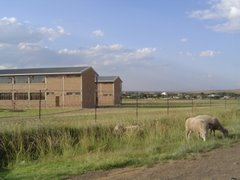
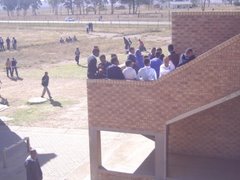
The view of Tweeling's township from the balcony at Refeng-Thabo.


South Africa has a very unique dynamic in the way that towns are set up. During apartheid, the towns themselves were reserved for white South Africans, black South Africans were restricted to what are called “townships” or “locations.” Mixed-race towns, like Sophiatown in Johannesburg, were cleared of black residents, who were relocated to the townships or to independent “Bantustans,” and bulldozed.


The idea was to keep black South Africans close enough to town to provide cheap labor, but far enough away that white South Africans could avoid black South Africans in any social situation in town.


As an added insult, the apartheid government enacted several different pass laws, requiring black South Africans to have a pass to be in an urban area or in the town. The only allowable reasons for being in town or in the city were for work or, for women, for the husband’s work. Black South Africans needed a pass to leave their township and to travel out of the established “homeland.”


Even tiny towns like Tweeling have a sizeable township. The town used to be completely white, with black South Africans not allowed to live in town. The town now is about half black and half white, with many black families owning and renting homes in town.
The township, on the other hand, is completely black and, for the most part, very poor. All of the students at Refeng-Thabo come from the township and these are photos of some of their homes.


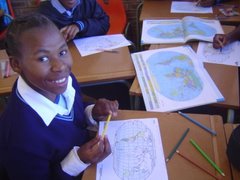
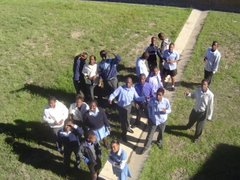
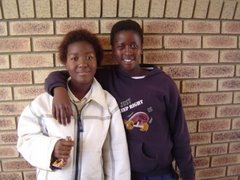
These students of Kate's happened to be out in the township while we were taking pictures.

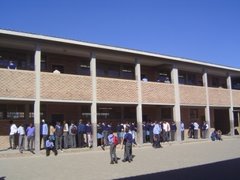
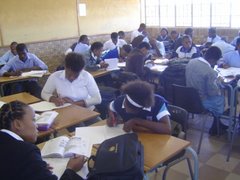
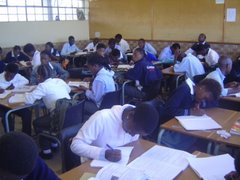
Refeng-Thabo's teachers are still on strike, so they have been out of school now for two weeks.


Tweeling’s township is now in the middle of the installation of a huge plumbing project that will provide sewer services to every house in the township. Currently, almost no houses in the township have indoor plumbing and none have sewer hook-ups. Most people get their water from a spigot in the yard, which they use for washing and cooking. Almost every home has an outdoor toilet that is either a pit or a bucket toilet. Washing is done, for the most part, with a bucket and a washcloth. Laundry is done in a basin and hung in the yard.


Kagiso Motale and Simphiwe Mohapi helped me to take these pictures of the houses in the Tweeling township. They explained to people why we were taking pictures, and most people were very glad that people in America would see their homes.


There are several nicer homes, like these, in the township. They are, however, very rare.


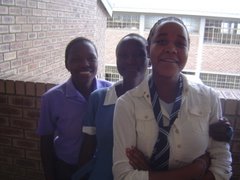
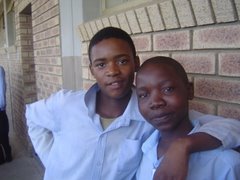
Difficult to see, but these are three of Kate's grade 10 and 11 history students.


The Rainbow clinic, where Andy works, is located at the edge of the township and serves mostly township residents. Nurses are included in the public servants' strike, but the clinic has remained open throughout the strike. Pressure from the nurses' union forced Lucy Mokoena, who runs the clinic, to close on Tuesday and Wednesday of this week, but she is determined to keep the clinic open for as long as she is able, as it is the only free medical care in Tweeling and the only medical care that most of Tweeling's residents have access to.

Wednesday, June 6, 2007

"The Teachers are Toyi Toyi-ing Miss"


The first week that I was at Refeng-Thabo, the school’s union organizer told me that there will most likely be a teacher strike this year. There are several teacher unions in South Africa, but everyone at Refeng-Thabo is a member of SADTU (South Africa’s Democratic Teacher Union), which has been calling for a 12% raise. The government offered 6%, which the unions were obviously not pleased with, and started threatening a strike.


Two weeks ago Friday (May 25th) all union members walked out of Refeng-Thabo at 10am to attend a union rally. On Monday the 28th, most union members did not attend school to go to Bloemfontein for a union march. All that week, the unions members were on a “slow down,” which meant that they came to work, but they did their work very slowly, and would not agree to do any extra work that is not in their contracts.

On Tuesday, the first day of the “slow down,” the teachers were doing the toyi-toyi (which means “protest”) dance in the staff room and these girls (who were supposed to be in my 10th grade history class) saw them and started doing their own dances…

Friday, June 1, the real strike started, and when I showed up to school, there was noone there and the gates and the school were locked. I called the district and they told me to go home, so Andy and I drove the rental car to the beach.


Part of my contract with Fulbright is that I am not allowed to strike and that I will come to school every day during the strike. On Monday, June 4, two other teachers and our school’s librarian showed up. It has been the four of us, the principal, and the office staff all week. The unions are not backing down from their 12% demands and the government is not budging from its second offer of 6.5%, which (surprisingly?) the unions didn’t accept. I polled the teachers before the strike started and most thought that it would last 3 days, some thought it would be only one. Now, most are saying that they would be very surprised if the strike ends before the June vacation, with school only resuming in July.


The first few days I brought my computer and worked all day to get a lot done for 3rd quarter. I got bored the third day and Principal Radebe suggested that I teach the other teachers about the two brand new computers that we received from the district. When I offered to help set up and show them how to use the machines, they jumped out of their seats. (Booth-Fickett's donations bought the power strip, which was the only way that we could use both computers at the same time. The first day, we had to take turns, as there are 2 computers with brand-new printers, but only one plug to connect them to.)


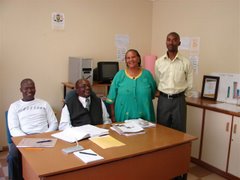
We worked all day on computer basics and everyone wanted to stay late to finish what they were working on. Today Mme Mngomezulu, our new English teacher, has brought an exam that she is working on typing and is very proud of her achievement.


Our cleaner, Mme Nhlapo, is using a computer for the first time and cannot believe it. I printed these photos for them so that they could show their families, who were awestruck.

ABSA Cup Championship in Durban


Before the car was stolen, we were having an absolute blast at the ABSA Cup Championships in Durban. We left for Durban at 5am on Saturday and drove straight to the beach. All over Durban people were wearing their team’s colors, bright yellow for the Sundowns and Red for CapeTown’s Ajax.


The Sundowns are a very wealthy team and can buy the good players (SA’s Yankees). They were the heavy favorites to win, having already won the South African Professional Soccer League. Sundowns’ fans also outnumbered CapeTown’s fans 2 to 1. Being true Red Sox fans, we rooted for the underdog.


Danny and Thokozile Motale joined us for the drive and the match. They wore their own team colors, black and gray for the Orlando Pirates.


The crowd filled ABSA Stadium, one of the stadiums that will be used for the World Cup in 2010, and made an impressive racket. Soccer fans here like to show their support by blasting away at any kind of noisemaker.


This fan broke out some kind of car part for the match that he could wind up and make a “zoom zoom” sound.


More common is the “Vuvuzela,” kind of like a giant kudzu that makes a sound exactly like its name.


The match was an upset, with CapeTown winning 2 – 0. There was a different kind of “upset” outside the stadium, but all is going well on that front. The insurance company has been wonderful and everything is being taken care of.

AND the Red Sox are 9 games up (AND the Yankees are losing the AL East).

Monday, May 28, 2007

This is definitely where we parked the car...

Last weekend we attended the ABSA Cup Championship soccer match, which is like the Superbowl in South Africa, in Durban. We had a great time at the game, but when we came out after Capetown’s win over Pretoria, our car was gone. No broken glass and no trace of the man who had promised to watch it for us (people offer to do this for you in South Africa, and many people believe them to be completely reliable. Not us) for $2. “What about the man who was watching your car?” is everyone’s first question.

Kate now has the dubious honor of having more cars stolen than anyone else that she knows! The Tucson Police couldn’t track down the red Civic which was parked 5 miles from where it was stolen (long enough to be captured on Google Earth). While the Durban Police were great, we don’t have much higher hopes for them finding the Corolla. Surprisingly, the insurance company here has been much more efficient and professional than my insurance company in the U.S.

The family that we bought it from, the McHugh’s, wrote to let us know that they had taken the car to Botswana, Zambia, and Lesotho, as well as all over South Africa. We like to wonder where it is now. It could be anywhere, or it could be lots of places, having been stolen and sold for parts…

We thought that we’d share a few pictures of the adventures that the Corolla took us on as a little tribute…


The Corolla on what we like to call "Corolla Safari" in Mkhuze Park.


The car parked on the street in Sharpeville (where it did not get stolen) when we paid a visit to Danny Motale's parents and extended family.


Reatlehile, Pontso, and Ntombi playing on the car. (Notice Reatlehile's hat)


Zambo playing "car."


Another entry in Andy's "Stuff on the Road" series.

Friday, May 25, 2007

More Photos from Tweeling!

Winter has definitely started in Tweeling and we have been FREEZING. Our house is so cold that we don't need to put the milk in the refrigerator. Wednesday morning the thermometer outside hit -8 degrees Celsius (17F!) and we remembered when it hit 29F in Tucson and everyone talked about it for days. We went out and bought several space heaters that have warmed up our house and have made it possible to climb out of bed for Kate to make it to Refeng-Thabo before school starts at 7:15.

We thought that we'd share some photos from warmer days.


First, our landlord and friend, Danny Motale, with his kids in the wheelbarrow.


It doesn't take long around here for a group of kids to assemble, especially if the camera is out. This photo is of the 7th St. Soccer Team / Dance Squad.


The roads in South Africa are very good, but we are glad to be reminded very often that it is still Africa. We've started taking pictures of people and animals that we have come upon in the road while we are driving. These women had spent all morning collecting the grass bundles that they are carrying back home for roof repairs.


While we have seen many incredible animals in South Africa, we've seen more cows than we can believe.


Andy and the girls had a balancing contest on a sunny afternoon. Ntombi, which means "daughter" in Zulu, is just holding on and Reatlele and Vanessa are climbing up for a challenge.


Kate and Mandla in the backyard. Mandla calls both Andy and Kate "Katie" and we are wondering what he thinks that "Katie" means (White people who like to throw me in the air?).


Andy, Zambo, Mandla, and Ntombi at halftime in a backyard soccer match. If you can get the soccer ball in the middle of the old tire, you get a point. If you can do it from across the yard, you get two points.


Andy, Mandla, and Ntombi.


Ntombi, Kate, and Mandla.


Mandla loves to be picked up, spun, and held upside down. When he sees Kate or Andy, he'll come running with both arms up.

Saturday, May 12, 2007

A Visit to the Lion Farm and Some Photos from Tweeling

This weekend we went to visit Darren and Karen Petersen, the other Fulbright teachers who live in Clocolan, about 2 hours south of Tweeling. They live in a lovely town and Darren gave us a tour of the school where he is teaching. His school is a former Model C school, which means that it was originally set up only for white students, but now the entire student body is black. The differences in the facilities from Refeng-Thabo, which was set up for Black students, were striking, and another reminder at the opportunities that were set aside for some in South Africa and denied to others.


On a much lighter note, Clocolan is located very close to a lion breeding farm, where lions are bred to be sold to private game reserves.


Darren and Karen took us to visit the lions and we were able to pat and hold the baby lions. The babies were very wary of us at first, but once they became comfortable with us being in their pen, they would follow us around and claw at us to pet them.


We happened to be visiting on the day that the lions are fed and we were able to watch their weekly feeding. The lions are fed chickens that are donated to the lion breeding farm from one of the egg farms.


Each lion was fed over 20 chickens and one growled at Kate when she walked too close to him when he was eating.


Back in Tweeling, Thokozile Motale, the mother of the family that we live with, graduated from University with an Honors B.A. degree in education and guidance. We celbrated her graduation the traditional South African way, by eating loads of meat.


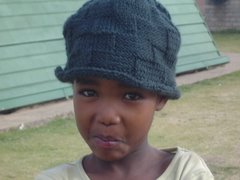
It is starting to get very chilly here in Tweeling, so Kate has been knitting caps for all of the neighborhood kids. They get to pick their colors and she works on them during breaks at school and during long car rides. Vanessa chose her favorite shirt for her photo.


Daniel "Shakes" Motaung chose red and blue to match his school uniform at the town's primary school.


Little Mandla doesn't have a school uniform because he's too little.


Pontso wanted a hat like Kate's, but in green. For a while all of the girls wanted green hats and the boys wanted red.


Zambo was one of the first boys to get a hat, when it was still really too warm for knit caps. He wore his hat every day, to school, to play soccer, to watch T.V., all while it was still in the 70's outside.

Tuesday, May 1, 2007

A Long Weekend at St. Lucia Wetlands Park and Mkhuze Game Reserve


This weekend we did one of our favorite trips that we have made during our time here. Friday, April 27th, is South Africa's Freedom Day, the anniversary of the election of Nelson Mandela. All of the schools in South Africa had April 30th as a school holiday and May 1st is Workers' Day. We had a five-day weekend from school, so we decided to take a trip a little bit farther than we usually would on a weekend. We left Thursday for the Greater St. Lucia Wetlands Park, South Africa's first UNESCO World Heritage Site.


The Park is home to thousands of hippos and crocodiles and includes a part that contains the “Big Five” game animals, elephants, lions, leopards, rhinos, and buffalo. We went on a horseback game ride, where we rode in a group to spot animals in the game park. We were able to get very close to zebras and blue wildebeests.


We spotted a gorgeous Kudu, the biggest that we’ve seen, in the Eastern Shores section of St. Lucia.


We also took a kayak trip to watch hippos and crocodiles. We were able to get fairly close to both hippos and crocodiles, which was scary and fun.

Our last night in St. Lucia the woman who runs the guesthouse where we were staying came out and told us that there were hippos outside. Believe it or not, the huge hippos eat only grass and come out of the water every night to eat over 40kg (about 90lbs) of grass. More people are killed by hippos than by any other game animal in Africa. They look very slow, because they are so fat and goofy, but they can run 52K per hour (about 30MPH) and stomp you very easily.


St. Lucia has a creepy, but very cool, crocodile center, where they have over 100 crocodiles and tons of information about crocodiles (and a ridiculous caution sign). They will let you watch the trainers feed the crocodiles dead, rotting chickens.


We also went to a snake demonstration at the crocodile center, where they let Kate hold a python.

For the second part of the long weekend we visited Mkhuze Game Reserve, 2 hours north of St. Lucia. Mkhuze is home to 4 of the “Big Five” animals, missing only lions. The park has constructed “hides,” little houses where you can watch animals without being seen. We went on a night game drive, where we saw a white-tailed mongoose and several tiny African Nightjaws (an adorable owl).


We also went on a bush walk at 6am with a guide armed with a rifle. We followed Sinyane, our guide through the trees and he pointed out the different birds and animals that we saw. We had been out for about an hour and a half when we saw a gorgeous giraffe, which Sinyane says was darker because it is very old.


Sinyane also spotted a white rhino lying down in the bush, which looked like a huge rock. He made some noise to get it to stand up for us, and we were able to take pictures of him walking around.

The second and third rhinos that we saw were a mama and baby. We walked up along side the two of them and took them by surprise. The mama rhino started running straight at us and Sinyane told us to climb up the closest tree. We were able to hide behind a bush while he scared the angry mama off by shouting and waving his rifle. Though Andy says that he wasn’t scared, I was, but in a fun, ridiculous way.

There were two more white rhinos by our cars, another mama and baby that we stayed a good distance from. In all, we saw 5 rhinos, 1 giraffe, about 50 blue wildebeests, about 10 zebras, and countless impala on our game walk.

We spent the next two days driving through the park, looking for animals. You’re not allowed to do any hiking in the park, for obvious reasons…